
Last Updated: November 17, 2026
Quick Summary
To measure for a bridal jacket, wear the undergarments you will wear on the day and use a soft tailor's tape to record bust, underbust, waist, hips, shoulder width, sleeve length, arm circumference, jacket length and back length. Measure jacket length from your shoulder point straight down, and back length from the base of your neck down the spine.
- Measuring at home takes about fifteen minutes and one helper.
- Measure twice, and if the two readings differ, take the average.
- Send five numbers as a minimum: bust, waist, hip, shoulder width and sleeve length.
- If your numbers land in two sizes, size to the larger measurement for a fitted jacket.
- Fitted lace jackets need 1 to 2 inches added at the bust for comfort.
Table of Contents
- Why Bridal Jacket Measurements Decide the Whole Look
- How to Measure for a Bridal Jacket at Home
- How to Measure for a Bridal Jacket in Inches
- What Measurements to Give for a Jacket When You Order
- Reading a Bridal Jacket Size Chart Without Guessing
- Jacket Length, Back Length and Fit Allowance by Style
- Troubleshooting Measurements That Keep Changing
- Send Your Measurements to TABD BRIDAL for a Made-to-Measure Fit
- Frequently Asked Questions
Why Bridal Jacket Measurements Decide the Whole Look
A bridal jacket sits at the top of your silhouette. It frames your face in every photo, meets your neckline, and controls how your shoulders read in the dress beneath.
A cover-up that fits well looks intentional. One that does not looks borrowed.
Below, we will show you exactly how to measure for a bridal jacket at home, in inches, with the tape placements that matter and the fit allowances to add for each style.
How to Measure for a Bridal Jacket at Home
Measuring for a bridal jacket at home takes about fifteen minutes and one helper. You need a soft tailor's tape, the undergarments you will wear on the day, a mirror, and a way to write numbers down as you go.
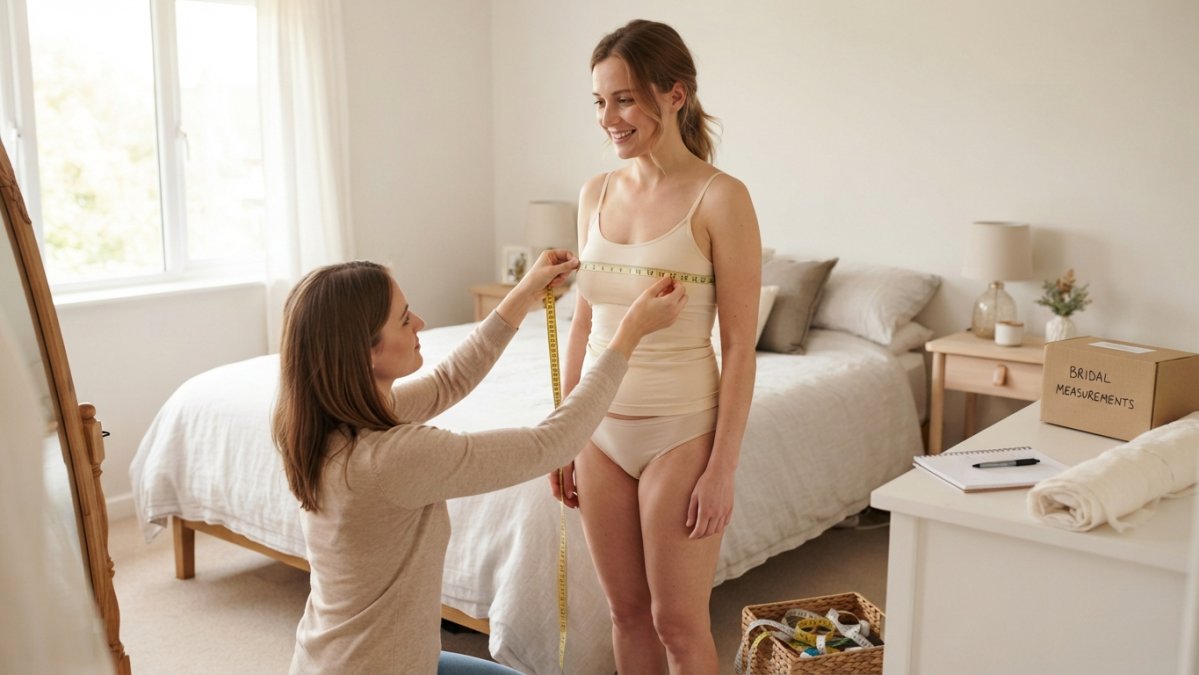
The sequence below is ordered for a jacket, not a dress. For consistent technique, see our guide to measuring for a wedding dress. Body measurements come first, then the jacket-specific lengths that decide where the hem lands over your gown.
Step 1: Set Up the Tape, Undergarments and Stance
Start with a soft tailor's tape, not a metal builder's tape. Stand tall with your arms relaxed at your sides, feet together, and breathe normally. Wear the bra or shapewear you plan to wear under the jacket, because those change your bust and underbust lines.
A common mistake is measuring over street clothes. You will add inches that do not exist on the day.
Step 2: Bust, Underbust, Waist and Hips
Keep the tape level and snug, not tight. You should be able to slide one finger under it.
- Bust: around the fullest part of your chest, tape level across your back and parallel to the floor.
- Underbust: directly beneath your bust, snug to the ribcage. This matters for cropped and fitted jackets that sit close under the bust line.
- Waist: at your natural waist, the narrowest point above your belly button. Bend sideways; the crease that forms is your natural waist.
- Hips: around the fullest part of your seat, usually about 20 cm (8 in) below the waist. This matters for longer jackets and coats that skim the hip.
Measure twice and write each number down. If the two readings differ, take the average.
Step 3: Shoulder Width, Sleeve Length and Arm Circumference
Shoulder width runs from the bony point of one shoulder, across your back, to the same point on the other side.
For sleeve length, start at the shoulder point and run the tape down a slightly bent arm to where you want the sleeve to end.
If you are pairing a jacket with detachable sleeves, our guide on how to size detachable wedding sleeves covers the extra points to check.
Step 4: Jacket Length and Back Length (the Bridal-Specific Step)
This is the step most general sizing guides leave out, and it is the one that decides whether a cropped, waist-length or longer bridal jacket sits where you expect over your gown.
- Jacket length: measure from the shoulder point (the same bony point you used for shoulder width) straight down the front to where you want the jacket hem to sit. For a cropped bolero, that is usually just below the bust or at the natural waist. For a waist-length jacket, it is at or just below the natural waist. For a longer jacket, it is at the hip or below.
- Back length: measure from the base of your neck (the prominent bone at the top of the spine) straight down the back to the same hem point. Jacket length and back length are not the same number on most bodies, and a maker needs both to place the hem correctly front and back.
Watch out: if you measure jacket length from the top of the shoulder seam of an existing jacket rather than from your body's shoulder point, you will usually record a shorter length than the maker needs, because the seam sits in from the bone.
Step 5: Record and Cross-Check
Write down bust, underbust, waist, hip, shoulder width, sleeve length, arm circumference, jacket length and back length, plus your height. Before you send them, cross-check two things: that the tape was level in every reading, and that your jacket length and back length make sense against the style you chose. If you are ordering remotely, ask the maker whether they want body measurements or finished garment measurements, because the two are not interchangeable.
How to Measure for a Bridal Jacket in Inches
If you are ordering from a US or UK size chart, convert every number to inches before you compare. Most charts list bust, waist, hip and shoulder width in inches, and a single centimetre slip can push you into the wrong size.
Use this quick reference:
| Measurement | Where the tape sits | Typical use |
|---|---|---|
| Bust | Fullest part of chest | Jacket chest and closure |
| Underbust | Beneath the bust | Fitted and cropped styles |
| Waist | Natural waistline | Waist seams and belts |
| Hips | Fullest part of seat | Longer jackets and coats |
| Shoulder width | Bone to bone across the back | Set-in sleeves and structure |
| Sleeve length | Shoulder point to sleeve hem | Sleeve fit |
| Arm circumference | Fullest part of upper arm | Sleeve comfort |
Round to the nearest half inch. Never round down on a fitted jacket.
What Measurements to Give for a Jacket When You Order
Send five numbers as a minimum: bust, waist, hip, shoulder width and sleeve length. Add your height and your usual dress size, because they help the maker sanity-check the rest.
For a made-to-measure piece, also include:
- Underbust and arm circumference
- The jacket length you want, measured from your shoulder point down
- Your wedding date, so the maker can plan the timeline
If you are new to ordering custom pieces, our buyer's guide to affordable made-to-measure wedding dresses walks through the whole process, from sending numbers to your first fitting.
Reading a Bridal Jacket Size Chart Without Guessing
A bridal jacket size chart maps your body measurements to a size range, and it is not the same as your street size. Always trust the numbers, not the label.
Here is how to read one without second-guessing:
- Find your bust measurement first, then check the waist and hip columns.
- If your numbers land in two sizes, size to the larger measurement for a fitted jacket.
- Check whether the chart lists body measurements or finished garment measurements. They are different.
- Look for a note on ease, the extra room built into the garment.
What most guides miss is that a chart built for dresses will not always suit a jacket. A jacket needs room at the shoulder and arm, where a dress can stretch.
Jacket Length, Back Length and Fit Allowance by Style
Fit allowance is the extra room between your body and the finished jacket.
As a general guide:
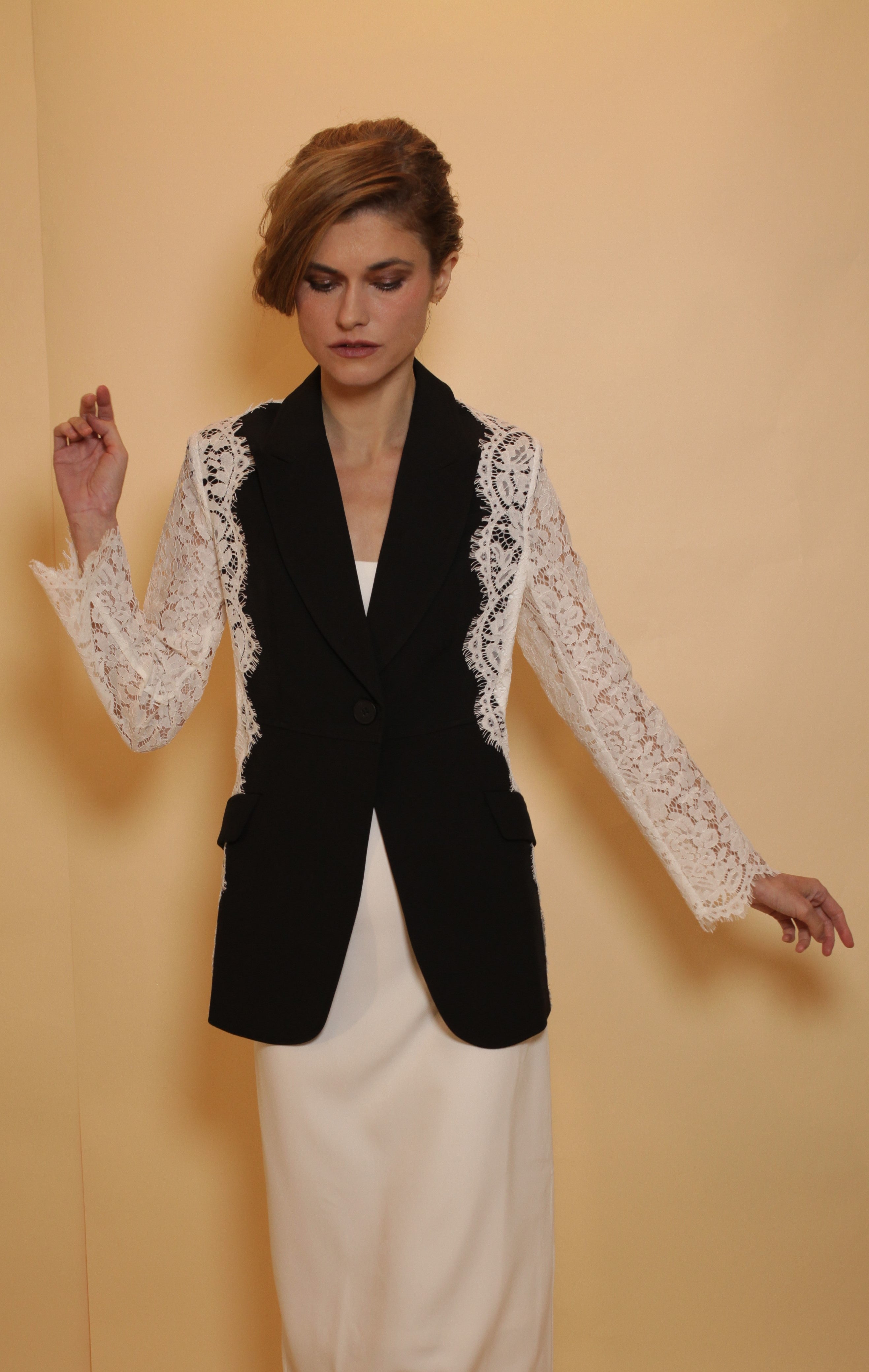
- Fitted lace jackets: add 1 to 2 inches at the bust for comfort. Lace has little stretch, so the allowance is what lets you breathe and move your arms without straining the closure.
- Structured or tailored jackets: add 2 to 3 inches at the bust and 1 to 2 inches at the waist so the jacket can close and layer over a dress with a defined waist or a corset back.
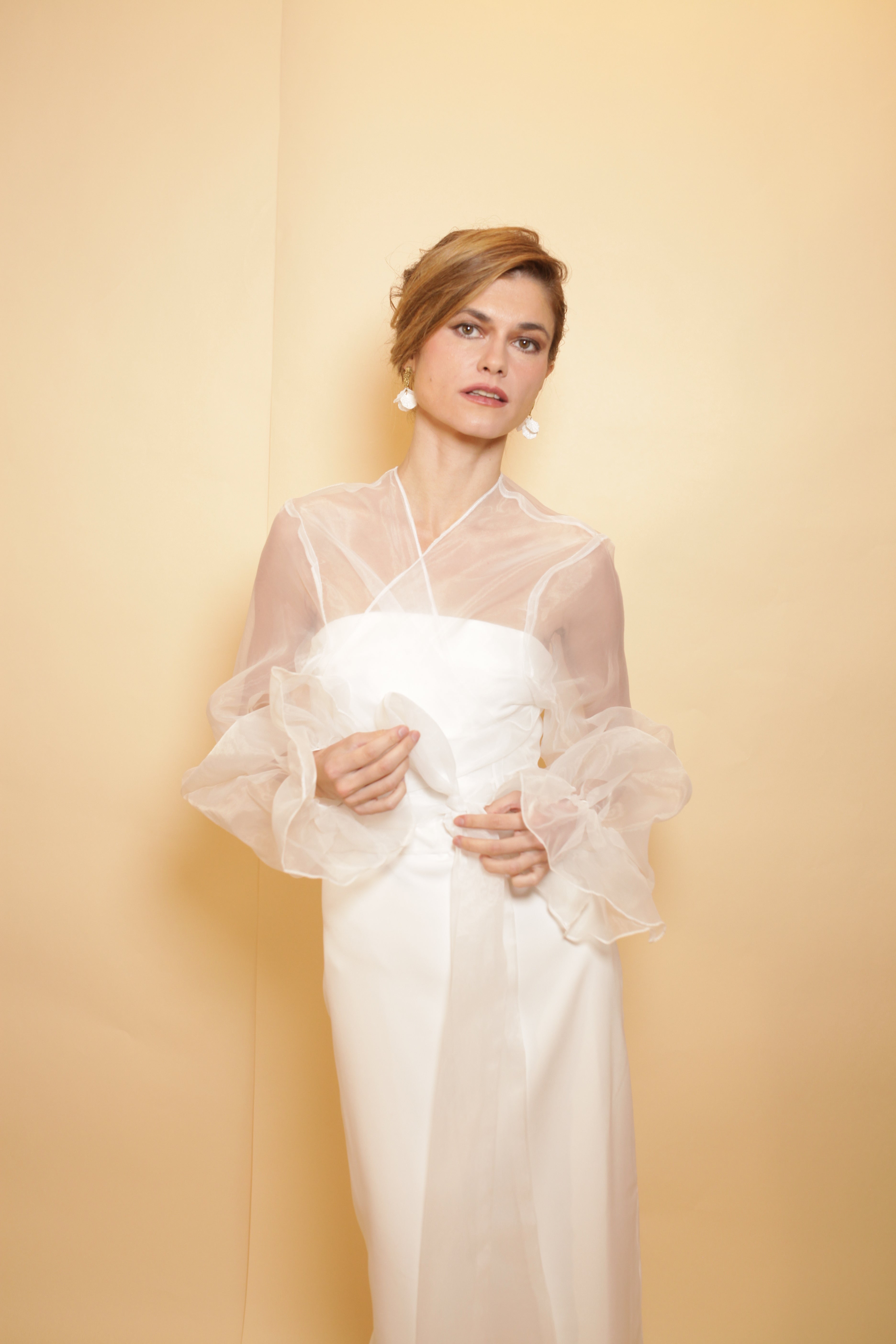
- Sheer organza wraps and shawls: one size, with a loose drape, so exact allowance matters less. The trade-off is that a one-size piece will not follow a fitted waist, so check the length against your gown rather than the bust.
- Wool and heavier fabrics: add a little more at the arm so the sleeve does not bind. Heavier fabrics do not compress the way lace does, so an arm circumference that fits in lace can feel tight in wool.
- Denim and leather bridal jackets: these have almost no give, so treat the measurements as exact and add ease only where you need to layer. A leather jacket that is snug at the shoulder will not relax the way a woven fabric will.
Jacket length is measured from the shoulder point straight down. Back length is measured from the base of your neck down the spine.
Comparing styles? Our organza bridal wrap-up jacket shows how a softer, one-size piece drapes over a gown, which helps you judge length before you commit.
Troubleshooting Measurements That Keep Changing
If your numbers move between readings, the tape is usually the problem, not your body. Here is how to fix the common issues.
- Tape slipping: measure in front of a mirror and have a helper hold the back level.
- Breathing in: measure at the end of a normal exhale, never while holding your breath.
- Different bras: measure in the bra you will wear on the day, every time.
- Tape twisted at the back: a twisted tape reads short. Smooth it flat before you note the number.
- Clothing bulk: measure over light undergarments only.
If two readings still differ by more than half an inch, take a third and use the middle number. That is the one to send.
Send Your Measurements to TABD BRIDAL for a Made-to-Measure Fit
Once your numbers are ready, send them to us and we will match them to the right piece. Our bridal lace jacket is made to measure and ships in two to four weeks.
A jacket that fits your body makes the whole look feel finished. Get started with TABD BRIDAL and send your measurements for a made-to-measure bridal jacket that fits you, not an average.
Measuring is the step most brides rush, and it is the one that decides how a jacket sits on the day.
Frequently Asked Questions
Should I wear my wedding dress when taking bridal jacket measurements?
Measure over the undergarments and layers you plan to wear on the wedding day, not over the dress itself. A bridal jacket sits on top of your gown, so the jacket needs ease built in for that layer. Take your bust, waist and hip measurements in the bra and slip you will actually wear, then tell the maker what dress silhouette goes underneath.
What should I do if my measurements fall between two jacket sizes?
Order to the larger measurement and plan for a small alteration, or choose made-to-measure so the jacket is cut to your numbers rather than a stock size. A jacket that is slightly too big can be taken in at the side seams and sleeves; one that is too small cannot be let out much. If your bust lands in one size and your waist in another, give both numbers and ask the maker to grade between them. TABD BRIDAL's made-to-measure jackets are cut from your own measurements, which removes the between-sizes problem.
How do I measure my bust, shoulders and sleeves for a jacket?
Run the tape around the fullest part of your bust, keeping it level across your back and parallel to the floor. For shoulder width, measure from the bone at the tip of one shoulder across the back of your neck to the matching point on the other side. For sleeve length, start at that shoulder point and run the tape down a slightly bent arm to where you want the cuff to end. Keep the tape snug but not tight, and measure twice to confirm each number.
What is a good bridal jacket for a fall wedding?
A wool lace sweater with faux pearl detail works well for cooler months because it adds warmth without hiding the dress. TABD BRIDAL's wool lace sweater is made from extra soft, light wool and is custom made to your sizes, so it layers cleanly over a gown. For a lighter cover-up, an organza shoulder cover or wrap jacket suits indoor venues and transitional weather. Match the jacket weight to your venue and ceremony time, and always measure with the layers you expect to wear.
