
Table of Contents
- Before You Start: Tools and Preparation for Measuring
- How to Measure Bust for Wedding Dress
- How to Measure Waist for Wedding Dress
- How to Measure Hips and Take a Hollow to Hem Measurement for Wedding Dress
- Reading a Wedding Dress Size Chart and Choosing Between Sizes
- Measuring Alone, Checking Consistency, and Timing Your Measurements
- From Measurements to Alterations and Final Fit
- Frequently Asked Questions
Last Updated: October 19, 2026
Before You Start: Tools and Preparation for Measuring
Learning how to measure for wedding dress sizing starts with two simple tools and ten quiet minutes. At TABD BRIDAL, accurate numbers now save costly alterations later.
Wedding dress sizing is not the same as street sizing. Bridal size charts run smaller than what you wear off the rack, so the tape decides your size, not the label in your closet.
Here is what to gather before you begin:
- A soft, flexible tape measure (not a metal builder's tape)
- A full-length mirror
- A helper, ideally
What to wear and how to stand
Wear a smooth, fitted bra or the shapewear you plan to wear with the gown. Bulky clothing adds inches that are not yours.
Stand straight with your weight even on both feet. Relax your shoulders and breathe normally.
Keep the tape snug against your skin but never pulled tight. A common mistake is yanking the tape, which shrinks your numbers and leads to a gown that will not zip.
How to Measure Bust for Wedding Dress
To measure your bust for a wedding dress, wrap the tape around the fullest part of your chest, level across your back and over the apex, keeping it snug but not tight.
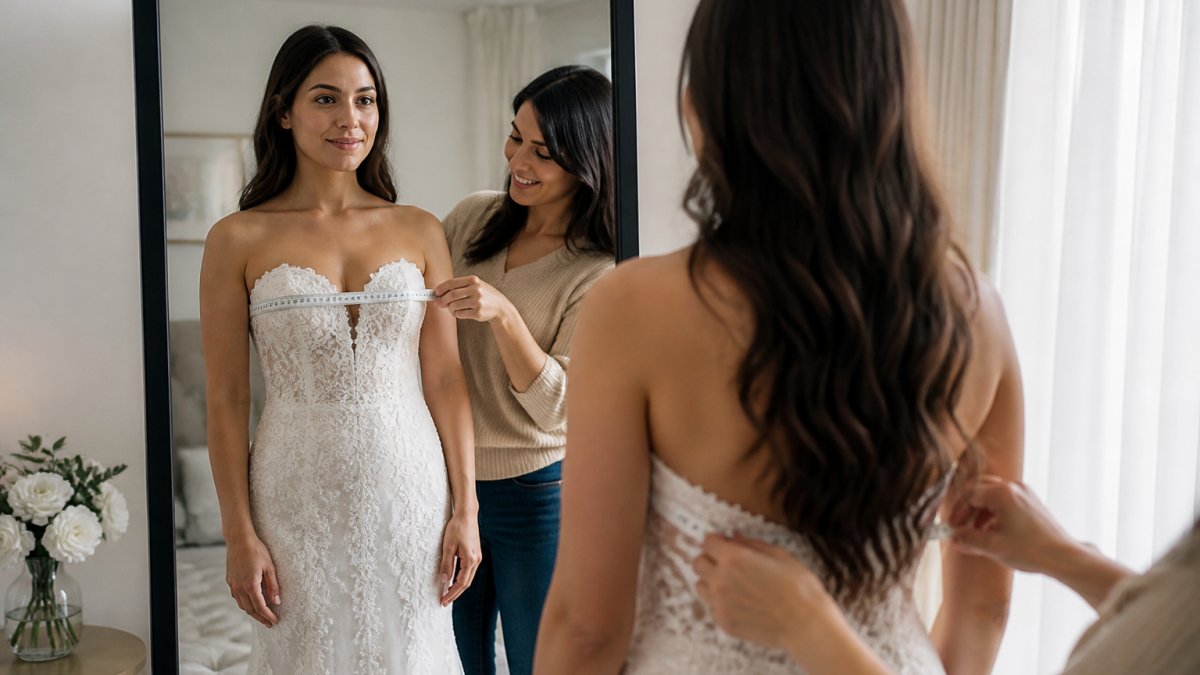
The steps, in order:
- Stand tall and face the mirror.
- Bring the tape around your back first.
- Cross it over the fullest part of your bust.
- Check in the mirror that the tape sits level all the way around.
- Exhale normally, then read the number where the tape meets.
Bust measurement is the single most important number for most gowns. A bodice that is too small will not close, no matter how the rest fits.
If you are between numbers, round up rather than down. A seamstress can take a gown in far more easily than she can let it out.
How to Measure Waist for Wedding Dress
Your natural waist sits at the narrowest part of your torso, usually just above the belly button and below the ribs.
Wrap the tape around that point, level with the floor, and keep it comfortably snug. Do not suck in your stomach.
A few practical checks:
- The tape should not dig into your skin.
- It should not sag at the back.
- Stand relaxed, not rigid.
Waist measurement drives the fit of A-line, ballgown, and fit-and-flare silhouettes. Get it wrong and the gown will pinch or gap at the waistline.
How to Measure Hips and Take a Hollow to Hem Measurement for Wedding Dress
Hip measurement is taken around the fullest part of your hips and rear, usually about 20 cm below your natural waist. Stand with feet together and keep the tape level.
The hollow to hem measurement for wedding dress sizing is the one most brides forget.
This number tells the maker where the hem should fall. It matters most for floor-length gowns and for anyone ordering a made-to-measure dress.
Shoulder and torso length
Two more numbers help for gowns with sleeves, straps, or structured bodices:
- Shoulder to shoulder: measure across your back from the tip of one shoulder bone to the other.
- Torso length: measure from the top of your shoulder, over the fullest part of your bust, down to your natural waist.
These numbers guide strap placement and bodice length. They are especially useful if you are ordering a made-to-measure gown, where the pattern is built around your frame rather than a standard block.
Reading a Wedding Dress Size Chart and Choosing Between Sizes
A wedding dress size chart maps body measurements to bridal sizes, and it rarely matches your street size. The chart is not a judgment of your body; it is a pattern-maker's block. Two gowns from two designers can put the same bust, waist, and hips into different size numbers, so always read the chart attached to the specific gown you are ordering, not a generic bridal chart you found elsewhere.
Here is how the three key numbers usually decide the size:
| Measurement | Where to Measure | If You Are Between Sizes |
|---|---|---|
| Bust | Fullest part of chest, level around back | Size up, then take in the bodice |
| Natural waist | Narrowest part of torso | Size up if the gown has a fitted waist |
| Hips | Fullest part of hips and rear | Size up for fitted or mermaid styles |
How to decide when you fall between sizes
Most bridal size charts move in increments of about 2 inches (5 cm) per size, so landing between two sizes is common. Use this decision order:
- Find your largest measurement on the chart. That number sets your starting size. If your bust is a size 10 and your waist is a size 8, start at the size that fits the bust.
- Check which measurement is hardest to alter on that silhouette. On a structured bodice, the bust and waist are the hardest to change cleanly. On a mermaid or trumpet, the hips are the hardest. Size to the measurement that governs the least-forgiving seam.
- Look at the seam allowance. A gown with generous side seams can be taken in by 1-2 sizes; a gown with narrow seams may only allow a small adjustment. If the chart puts you between sizes and the seam allowance is tight, size up rather than down.
- Ask the retailer or seamstress before ordering. A quick message with your three numbers and the gown style usually gets a clear recommendation. Most bridal fitters would rather answer that question than handle a return.
A common pattern is to size to the bust and waist first, because those are the hardest areas to alter cleanly. Hips are more forgiving on A-line and ballgown shapes, where the skirt falls away from the body.
Why silhouette and fabric change the decision
A structured satin ballgown and a fluid crepe sheath can call for different sizes on the same body. Structure holds its shape and shows every pull at the seams, so a structured bodice has less tolerance for a too-small measurement. Fluid fabrics drape and skim, which can hide a small gap but also cling where the fit is tight.
- Structured bodices (satin, mikado, boned corsets): size to the bust and waist; alterations are possible but visible if overdone.
- Stretch or crepe sheaths: a little give in the fabric can absorb a small difference, but the hips still govern the fit.
- Mermaid and trumpet: the hips and upper thigh are the limiting measurement; size to the hips even if the bust suggests a smaller size.
Do not assume your street size transfers. A bride who wears a size 8 off the rack may be a bridal size 10 or 12 on the designer's chart. The tape, not the label, decides.
Measuring Alone, Checking Consistency, and Timing Your Measurements
Measuring solo is doable, and most brides who order online end up doing it. The trick is to use the mirror as your helper and to build in a repeat check so a tilted tape does not become an expensive mistake.
How to measure yourself without a helper
Stand in front of a full-length mirror with your back to it, or angle the mirror so you can see your back. Bring the tape around your back first, then cross it over the front.
A workable solo method for each measurement:
- Bust: hook the tape at the fullest point in front, walk it around your back, and check in the mirror that the back run is level. Exhale, then read the number at the front.
- Waist: find your natural waist by bending to one side; the crease is your landmark. Wrap the tape around that point, check the back in the mirror, and read on a normal exhale.
- Hips: stand with feet together, wrap around the fullest part of the hips and rear, and confirm the back is level in the mirror.
If you truly cannot see your back, measure in front of a door frame or wall and use the tape's own markings to check that both ends sit at the same height.
The repeat-measurement consistency check
Take each measurement twice and compare. If the two numbers differ, remeasure before you record anything.
- Measure bust, waist, and hips twice each
- Confirm the tape is level in the mirror every time
- Note the date of each measurement
Inconsistent readings usually mean the tape tilted, your posture shifted, or you inhaled while reading the number. Fix the cause, not the number. A common pattern is for the second reading to be smaller because the bride relaxes; if that happens, trust the relaxed reading, not the first one.
When to measure and when to remeasure
Timing matters as much as technique. For made-to-measure orders, measure about two to three months before the wedding, which leaves room for alterations. If your weight tends to shift, remeasure closer to the date and compare against your original numbers.
Many brides see small changes in the final weeks from stress, training, or daily fluctuation. A change of 1-2 cm is normal and usually does not change your size; a change of a full size or more is worth a conversation with your seamstress or retailer before the gown is cut.
From Measurements to Alterations and Final Fit
Your measurements are the starting point, not the finish line.
Expect at least one fitting, often two or three.
At TABD BRIDAL, our made-to-measure dresses are built around your numbers, which cuts down on the alterations needed later.
If you are shopping online and cannot try anything on, accurate measurements are your safety net.
Measuring for a wedding dress takes ten minutes and a steady hand, but it decides how the gown feels on the day.
Ready to find your fit?
Frequently Asked Questions
Is a wedding dress size the same as my regular dress size?
No. Bridal sizing runs differently from street sizing, and a wedding dress size is often one to three sizes larger than what you wear in everyday brands. That is why a wedding dress size chart should always be read against your actual body measurements, not the number on your jeans. Take your bust, waist, and hip measurements with a flexible tape measure, then match those figures to the chart for the specific gown you are ordering. Ignore the label size entirely and let the numbers decide.
What should I wear when taking wedding dress measurements?
Wear the undergarments and shoes you plan to wear on the day, or something with similar support and shape. A smooth, unpadded bra gives a more accurate bust reading than a sports bra, and heels change your hollow-to-hem measurement. Stand straight, relax your shoulders, and breathe normally rather than holding your stomach in. Keep the tape snug but never pulled tight, and make sure it stays level around your body. Measuring in bulky clothing adds inches that do not exist.
Should someone else take my measurements, or can I do it alone?
A helper gives the most reliable readings, especially for the bust and hollow-to-hem, because they can see whether the tape is level at the back. If you are measuring alone, stand in front of a full-length mirror, use a flexible tape measure, and take each measurement two or three times. If your numbers vary by more than about a centimetre, redo that measurement. For a made-to-measure gown, it is worth asking a friend to double-check before you order.
How do I choose a size if my measurements fall between two sizes?
Order the size that fits your largest measurement, then plan for alterations on the smaller areas. Taking a dress in is straightforward for a seamstress; letting it out is limited by the seam allowance, so sizing up is the safer choice. Check the wedding dress size chart for the exact gown, since charts differ between silhouettes and designers. If you are ordering made-to-measure, share your exact measurements instead of picking a size, and the gown is cut to your figures from the start.