
Table of Contents
- What Drives Wedding Dress Alterations Cost in 2026
- Bridal Alterations Price List: What Each Service Typically Involves
- Wedding Dress Hemming Cost and Why Layers Change the Price
- Wedding Dress Bustle Cost: Train Length, Buttons, and Build
- Wedding Dress Alteration Timeline and Booking Windows
- How to Compare Written Quotes and Build a Sample Budget
- Conclusion
- Frequently Asked Questions
Last Updated: October 20, 2026
What Drives Wedding Dress Alterations Cost in 2026
Wedding dress alterations cost is driven by three variables: labor hours, gown complexity, and whether your tailor charges by the hour or a flat fee.
At TABD BRIDAL, we see brides buy an affordable minimalist gown and discover the alteration bill rivals the dress price. The gown was never the expensive part. The fit work is.
Most brides budget for the dress and treat alterations as an afterthought. Reverse that: alterations are where a gown becomes yours.
Labor, Complexity, and the Hourly vs. Flat Fee Question
Bridal alterations cost is the total a seamstress or bridal tailor charges to reshape a finished gown to your measurements, billed two ways. Hourly billing rewards simple jobs and punishes indecision.
Which is cheaper depends on your gown. A clean crepe sheath is a fast hourly job; a beaded ballgown with six layers and a cathedral train is not, and a flat fee quoted before the tailor sees the inside of the dress is a guess, not a price.
Bridal Alterations Price List: What Each Service Typically Involves
A bridal alterations price list should itemize every service your gown needs, because a lump-sum figure tells you nothing about where you are overcharged. The table below gives 2026 planning ranges, not quotes. Labor rates, local cost of living, and currency move the numbers, so confirm every line with your tailor in writing.
| Service | What It Involves | Typical 2026 Range (USD) | Cost Driver | Typical Complexity |
|---|---|---|---|---|
| Hem | Shortening length, sometimes across multiple layers | $150-$500+ | Number of layers, lace edge, horsehair | Low to high |
| Take in | Reducing waist, side seams, or bodice | $120-$400 | Boning, lining, beading at seams | Medium |
| Let out | Releasing seam allowance | $100-$350 | How much seam allowance remains | Medium to high |
| Strap adjustment | Shortening or repositioning straps | $40-$120 | Beaded or detachable straps | Low |
| Bustle | Adding buttons, loops, or ties to lift the train | $100-$500+ | Train length, weight, fabric | Medium |
| Sleeve adjustment | Reshaping or shortening sleeves | $60-$200 | Lace, sheer fabric, cuffs | Medium |
| Customization | Adding straps, changing neckline, redesign | $150-$800+ | Scope of the redesign | High |
Two things stand out on any honest price list. First, hemming is rarely the cheap job brides expect, because a wedding gown hem is not one cut.
Regional and Currency Differences
These ranges are US-oriented. A hem quoted at $250 in a mid-size US city may be £120-£180 in the UK or AUD $200-$350 in Australia, reflecting labor rates, rent, and currency rather than quality. Convert to your own currency and adjust for local labor norms before judging a price.
A Line-Item Sample Budget
Instead of a single total, build your budget from the services your gown actually needs. A typical starting point for a gown requiring hem, take-in, strap adjustment, and a three-point bustle looks like this:
| Budget Line | Estimated Range (USD) |
|---|---|
| Hem (single layer) | $150-$250 |
| Take in (bodice) | $150-$300 |
| Strap adjustment | $40-$80 |
| Three-point bustle | $100-$200 |
| Fittings (if billed) | $0-$150 |
| Contingency (10-15%) | $50-$150 |
| Estimated total | $490-$1,130 |
A complex gown with a beaded bodice, multi-layer hem, and cathedral train can push the same categories to $1,500-$2,500 or more. The line-item approach shows which service drives the total so you can prioritize.
Wedding Dress Hemming Cost and Why Layers Change the Price
Wedding dress hemming cost is the most variable line on your alteration bill because hemming is priced per layer, not per dress. A minimalist gown with one clean layer is straightforward.
Each layer must be measured, cut, and re-finished separately, and some fabrics cannot simply be cut and sewn.
That is why two brides with the same dress length can get wildly different hemming quotes: the length is identical, the construction is not.
If you are shopping for a gown and want to keep alteration costs down, a clean single-layer hem is one of the most budget-friendly construction choices you can make. Our made-to-measure dresses at TABD BRIDAL are cut to your measurements from the start, which reduces how much hemming and taking-in the gown needs after it arrives.
Wedding Dress Bustle Cost: Train Length, Buttons, and Build
Wedding dress bustle cost depends on how much train you are lifting and how the bustle is built. A short sweep train with a three-point bustle is modest. A cathedral train on a heavy beaded gown needs a multi-point bustle with reinforced anchors, a different category of work.
Bustle styles vary, and each has a cost implication:
- Three-point bustle: the standard for light trains, quick to build
- Five-point or seven-point bustle: needed for heavier trains to distribute weight
- French bustle: ribbons underneath lift the train in folds, more labor-intensive
- Ballroom bustle: the train tucks under to look like a floor-length gown, complex construction
- Wrist loop: simplest option, but only suits very light trains
Weight matters as much as length. A heavily beaded train needs anchors strong enough to survive hours of dancing, and reinforcing them is skilled work. Skipping it is how bustles fail mid-reception.
Wedding Dress Alteration Timeline and Booking Windows
The wedding dress alteration timeline typically runs six to eight weeks from first fitting to final pickup, but the booking window matters more. Book your first appointment the moment your gown arrives.
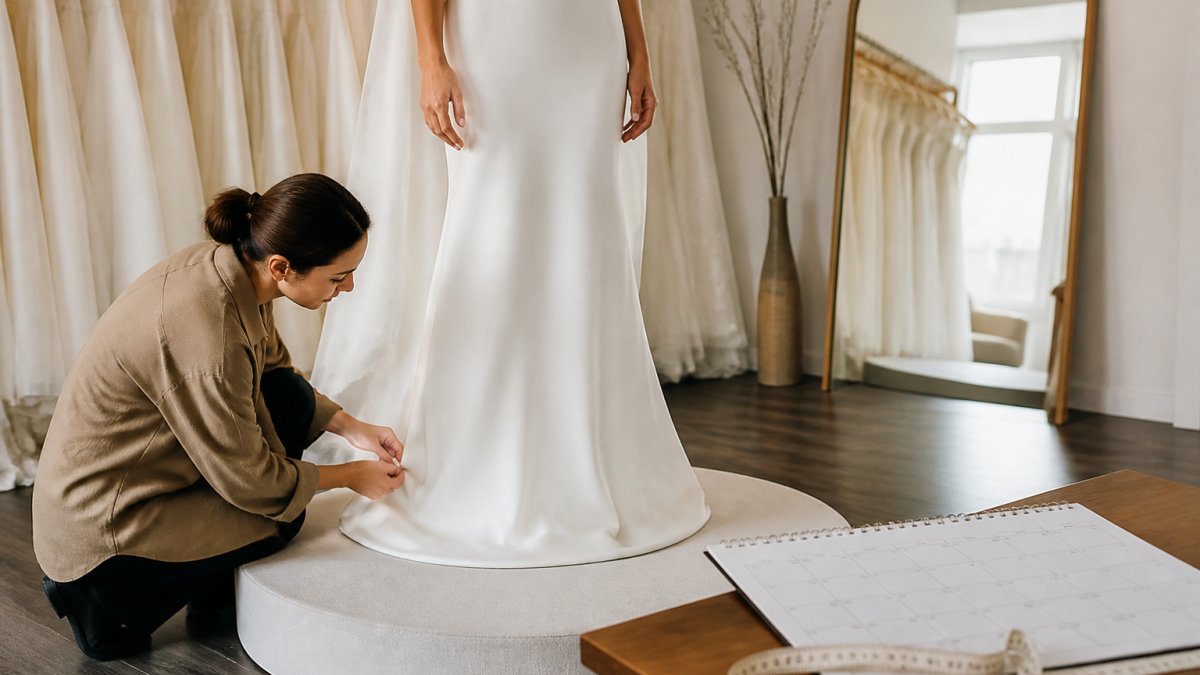
Here is a realistic sequence to plan around:
- Gown arrival to first fitting: book within one to two weeks of delivery
- First fitting: full assessment, measurements, itemized quote
- Second fitting: usually two to three weeks later, checks the work in progress
- Final fitting: one to two weeks before the wedding, with shoes and undergarments
- Pickup: a few days before the event, after any last adjustments
Most gowns need two to three fittings; complex redesigns or heavily beaded gowns need more.
Rush fees are real and avoidable. Tailors charge express rates when a gown arrives with weeks to spare instead of months, stacking on top of the base alteration price.
How to Compare Written Quotes and Build a Sample Budget
Comparing written quotes is where most brides leave money on the table, because quotes are rarely formatted alike. One tailor lists a single "alterations" line; another itemizes twelve services. Normalize both before comparing. The goal is not the cheapest number but understanding what each includes and excludes.
What a Written Quote Should Specify
Use this checklist when you receive a quote:
- Is every service itemized separately with a price?
- Is the hem quoted by layer count?
- Is the bustle priced by point count and style?
- Are embellishment handling charges listed separately?
- Is there a stated rush fee, and what triggers it?
- What is the deposit amount and is it refundable?
- What are the cancellation terms?
- Is tax included or added on top?
- What is the payment schedule: deposit, mid-point, pickup?
- Which services are explicitly excluded, and what happens if they are discovered mid-fitting?
That last point matters most. A quote excluding beadwork handling or lining reconstruction is not wrong, just incomplete, and the excluded work is exactly what tends to appear at the second fitting. Ask the tailor to state in writing how additional work is priced and whether you will be notified before it is performed.
Flat-Rate vs. Hourly Pricing
Flat-rate quotes are easier to budget but can hide charges for complex embellishment or structural work. Hourly quotes are more transparent about labor but expose you to cost if fittings run long or decisions change. To compare, ask each tailor to estimate the hours a job will take and multiply by their hourly rate. If the flat rate is far below that figure, ask what is excluded; if far above, ask what contingency is built in.
Three Sample Budgets: Basic, Typical, and Complex
The clearest way to plan is to model three scenarios and see how add-ons and contingency change the total. The figures below are planning estimates in USD and will vary by region and gown.
| Budget Line | Basic Gown | Typical Gown | Complex Gown |
|---|---|---|---|
| Hem | $150-$250 (single layer) | $250-$400 (two layers) | $400-$600+ (lace/horsehair) |
| Take in | $120-$200 | $200-$300 | $300-$450 (boned/beaded) |
| Strap/sleeve | $40-$80 | $80-$150 | $150-$250 |
| Bustle | $100-$150 (three-point) | $150-$300 (five-point) | $300-$500+ (ballroom/French) |
| Embellishment handling | $0 | $50-$150 | $150-$400 |
| Fittings (if billed) | $0-$100 | $100-$150 | $150-$250 |
| Rush fee (if late) | $0-$150 | $100-$250 | $200-$400 |
| Contingency (10-15%) | $50-$100 | $100-$200 | $200-$350 |
| Estimated total | $460-$1,030 | $1,030-$1,900 | $1,850-$3,200+ |
The basic column assumes a clean, single-layer gown booked well ahead; typical assumes a lined gown with some structure and a moderate train; complex assumes beading, lace appliqué, multiple layers, and a long train.
Conclusion
The challenge with wedding dress alterations is that the bill arrives in pieces, across fittings, with add-ons discovered along the way, and brides who did not plan end up making rushed decisions at the worst moment. TABD BRIDAL's made-to-measure dresses are cut to your measurements from the start, our minimalist and courthouse styles keep hem and layer complexity low, and our full accessory range lets you plan the whole look in one place.
Frequently Asked Questions
What is the average cost of hemming a wedding dress?
Hemming is rarely a single price because it depends on how many layers the skirt has. A simple single-layer crepe or satin hem sits at the lower end, while a hem that passes through lace, tulle, and a lining costs more because each layer is marked, cut, and re-finished separately. Ask your bridal tailor for a per-layer quote in writing, and confirm whether the hem includes pressing and re-beading any detail that sits near the floor.
Does the cost of a wedding dress include alterations?
Almost never. Off-the-rack and sample-sale dresses are sold as-is, and alterations are a separate line in your budget. Made-to-measure dresses reduce the amount of adjustment needed, but most brides still pay for a final fitting and small tweaks. When you compare gown prices, add an alterations allowance so the total reflects what you will actually spend.
Which wedding dress alterations usually cost the most?
Bustles, bodice reconstruction, and any work involving beading or lace appliqué tend to sit at the top of the bridal alterations price list. A bustle needs multiple anchor points and a fitting to test the drape. Taking in a bodice through the side seams and lining takes specialized labor. Beaded straps and illusion backs are slow, hand-finished work, so expect those to cost more than a plain hem.
How many fittings do you need for wedding dress alterations?
Most brides need two to three fittings. The first pins the adjustments, the second checks the fit after the main work, and a final fitting confirms the hem, bustle, and strap tension. Complex redesigns or heavily beaded gowns can need a fourth. Book the first fitting about eight to ten weeks before the wedding so there is room for a re-check without rush fees.
When should you book wedding dress alterations?
Start the conversation with your bridal tailor as soon as the dress is in your hands, ideally ten to twelve weeks before the wedding. The wedding dress alteration timeline needs buffer for fabric orders, bead matching, and a second fitting. If you are buying a sample-sale or preowned dress, book earlier because the gown may need more structural work than a new one.
How do you compare alteration quotes fairly?
Ask every quote to list each service separately: hem, take in, let out, bodice adjustment, strap adjustment, bustle, and pressing. Confirm whether the price is a flat fee or an hourly rate, whether fittings are included, and what happens if the dress needs a second round of work. A quote that names each task is easier to compare than one lump sum, and it protects you if the scope changes.