
Last Updated: October 23, 2026
Quick Summary
Yes, an affordable courthouse wedding dress is worth it when the construction holds up, the fit is right, and the total cost stays below what a traditional gown would cost after alterations. Judge quality by seams, lining, closures and internal support rather than price, since a $168 dress needing no alterations beats a $400 dress needing $200 of work.
- Ask for the fabric's name, whether the dress is fully lined, and whether the bodice has internal support.
- Made-to-measure dresses ship in 2 to 4 weeks, so confirm production and shipping times in writing.
- Do not buy a dress two sizes up to alter it down; the alteration bill often exceeds the savings.
- An affordable minimalist dress carries a lower alteration bill, but accessories add up regardless of dress cost.
- A $210 midi dress worn three times costs $70 per wear, far less than a gown worn once.
Table of Contents
- The Real Verdict on Affordable Courthouse Wedding Dresses
- Courthouse Wedding Dress Quality: What Separates a $168 Dress From a $759 One
- Online Wedding Dress Shopping: How to Judge a Dress You Can't Touch
- Wedding Dress Sizing and Measurements: Why Made-to-Measure Changes the Maths
- Courthouse Wedding Dress Alterations: Budgeting for the Hidden Cost
- Total Cost of Ownership: Affordable vs Higher-Priced Bridal Dresses
- Which Dress Should You Pick? A Decision Framework by Budget and Priorities
- Frequently Asked Questions
The Real Verdict on Affordable Courthouse Wedding Dresses
Yes, an affordable courthouse wedding dress is worth it when the construction holds up, the fit is right, and the total cost stays below what a traditional gown would cost after alterations.
Below, we break down what the price tag buys, how to judge quality online, and how to calculate total cost of ownership.
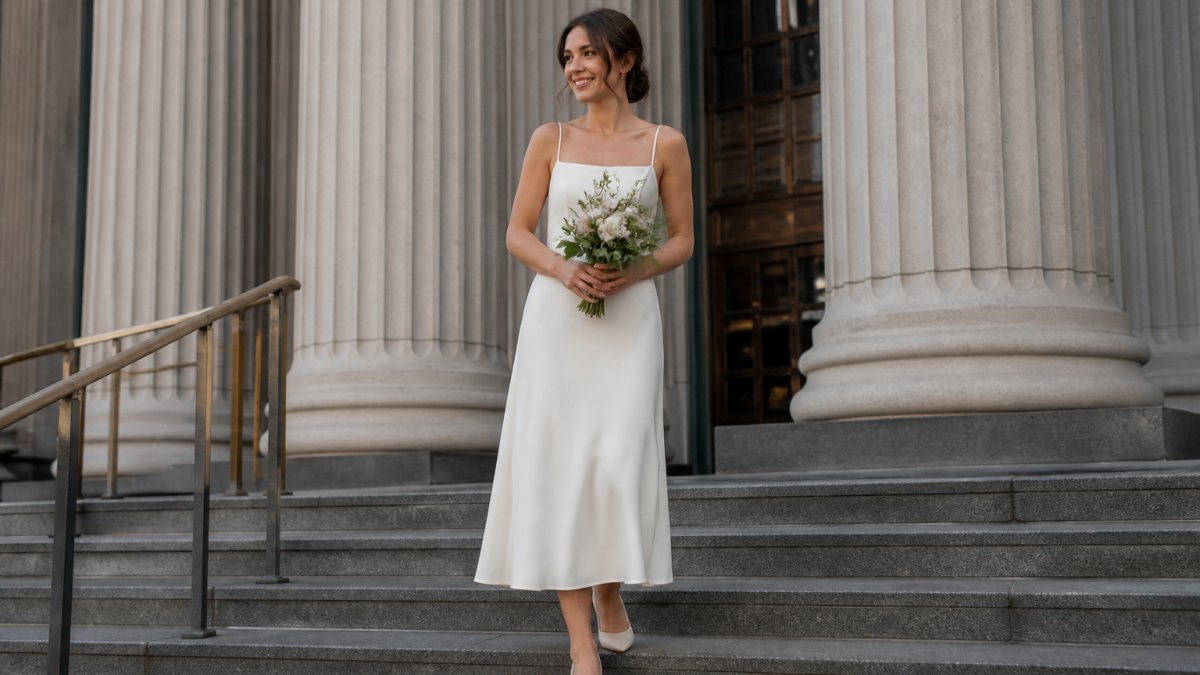
What the Price Tag Actually Buys
Price in bridal separates into three things: fabric, construction, and fit. Fabric is the most visible and least reliable signal, a dress can photograph beautifully in soft crepe and still have no structure in the bodice.

Construction is where the money goes: look for a full lining, a proper waist seam, and a closure that sits flat. Fit is the third cost, and the one budget shoppers forget.
Courthouse Wedding Dress Quality: What Separates a $168 Dress From a $759 One
Price tiers predict where the money went, not whether the dress is good. A $168 dress and a $759 dress can both be worth it, they just spend the budget differently.
At the lower end, expect simpler patterns, fewer seams, and machine-finishable construction, a design choice that suits minimalist courthouse looks.
But tier language is marketing. The useful skill is inspecting a dress, in person or through a listing, so you can judge quality independent of price.
The Pre-Purchase Quality Checklist
Work through these in order. If a listing or a salesperson cannot answer a question, treat that as a data point.
- Seams. Turn the dress inside out. Seams should be finished (overlocked, bound, or French-seamed), not raw and fraying. Puckering along a seam usually means it was sewn under tension and will distort when worn.
- Lining. A lined bodice holds its shape and hides undergarments; an unlined one in a light fabric shows every seam and shadow in photos. Ask whether the bodice and skirt are lined, and whether the lining matches your skin tone or the shell fabric.
- Fabric feel. Named fabrics behave predictably: soft crepe drapes and presses well, silk faille holds a crisp shape, guipure lace has weight and body. "Premium fabric" tells you nothing, ask for fiber content.
What the Price Tiers Actually Buy
- Under $250: simpler patterns, fewer seams, machine-finishable construction. Best for minimalist and modern looks where clean lines are the point.
- $250 to $450: heavier fabrics such as silk faille, added surface detail, more complex silhouettes, and more construction hours per dress.
- $450 and above: hand-applied lace, custom lining, and detail work that takes hours per dress.
None of these tiers is "better", they answer different questions. A $168 minimalist crepe dress that fits and needs no alterations beats a $759 lace dress needing $200 of work, and the reverse holds if the lace is what you will actually wear and love.

The Three Questions That Decide It
When buying online, ask the fabric's name, whether the dress is fully lined, and whether the bodice has internal support. If a listing cannot answer those three questions, quality is a gamble regardless of price. A dress that passes the checklist at $168 is worth more than one that fails it at $759.
Online Wedding Dress Shopping: How to Judge a Dress You Can't Touch
Online wedding dress shopping works when you treat the listing as a specification sheet, not a photograph. Photographs are styled; specifications are not.
Three things to look for before you order:
- Named fabric. "Soft crepe," "silk faille," and "guipure lace" tell you something. "Premium fabric" tells you nothing.
- Lining stated explicitly. A lined bodice behaves differently from an unlined one, and the listing should say which you are getting.
- Made-to-measure vs. off-the-rack. This is the single biggest variable. Our dresses are made to your measurements, which changes the alteration maths entirely.
Return Policies, Sizing Risk and Buying Timelines
Sizing risk is the real cost of buying online, and it splits by production model. Off-the-rack dresses can usually be returned or exchanged, but fit whoever the standard block fits.

Timelines matter too. Our made-to-measure pieces ship in 2 to 4 weeks. If your ceremony is inside a month, confirm production and shipping times in writing before ordering.
Federal Trade Commission guidance on online shopping and return policies
Wedding Dress Sizing and Measurements: Why Made-to-Measure Changes the Maths
Wedding dress sizing and measurements decide whether an affordable dress stays affordable. Standard sizing assumes fixed proportions most bodies do not match exactly, the gap alterations exist to close.
Made-to-measure removes most of that gap: you supply bust, waist, and hip measurements, and the dress is cut to them.
Measure over the undergarments you plan to wear, keep the tape level and snug but not tight, and have someone else read the numbers.
Casual short wedding dress, Engagement party, beach wedding, elopement →
Courthouse Wedding Dress Alterations: Budgeting for the Hidden Cost
Courthouse wedding dress alterations are the line item that turns a budget dress into a mid-range one. A hem is straightforward; taking in a bodice, rebuilding a shoulder, or shortening a lined lace skirt is not.
Budget by complexity, not by dress price:
| Alteration | Typical Complexity | What Drives the Cost |
|---|---|---|
| Hem shorten (plain) | Low | Number of layers |
| Hem shorten (lace) | High | Hand-finishing required |
| Bodice take-in | Medium | Whether the dress is lined |
| Strap or shoulder adjustment | Low to medium | Beaded or plain |
| Full bodice rebuild | High | Structure and boning |
The cheaper the dress, the more likely it needs work. A dress cut to your measurements starts closer to finished.
Total Cost of Ownership: Affordable vs Higher-Priced Bridal Dresses
Total cost of ownership is the number that actually answers the query, and it is not the price tag.
Here is how the maths usually breaks down.
| Cost line | Affordable courthouse dress (e.g. $168-$289) | Higher-priced bridal gown (e.g. $1,200+) |
|---|---|---|
| Dress | $168-$289 | $1,200+ |
| Alterations | $0-$150 (often minimal if made-to-measure) | $200-$500+ (structured bodices and heavy fabrics cost more per hour) |
| Shipping and returns | Usually included or modest; return window matters | Often significant; made-to-order may be non-returnable |
| Accessories (veil, shoes, jewelry) | $50-$250 | $150-$600+ |
| Cleaning | $30-$80 | $100-$250+ |
| Resale or reuse value | High if short/midi and rewearable; resale possible | Low resale as a percentage of price; rarely rewearable |
| All-in, first wear | Roughly $250-$750 | Roughly $1,650-$2,550+ |
The pattern is consistent: an affordable minimalist dress carries a lower alteration bill. Where costs converge is accessories, a veil, cape, and jewelry add up regardless of dress cost.
That is why buying a complete look from one place removes a whole category of mismatch risk and keeps the total visible in one number instead of scattered across three orders.
Cost Per Wear and Post-Wedding Reuse
Cost per wear is where a courthouse dress wins outright.
Divide the price by realistic wears. A $210 midi dress worn three times costs $70 per wear. A gown worn once costs its full price per wear.
Reuse also changes the resale maths. A rewearable midi holds value because a second-hand market exists for it; a heavily beaded ballgown is harder to resell and usually sells at a steep discount.
The Buying-Risk Line
One cost line the table cannot capture is risk. Off-the-rack dresses can usually be returned or exchanged, but they fit whoever the standard block fits. Made-to-measure dresses fit you, but they are cut for you and typically cannot be resold, so returns are limited. That trade-off is the real reason measurement accuracy matters more than the return policy on a made-to-measure order.
Consumer advice on understanding value and total cost
Which Dress Should You Pick? A Decision Framework by Budget and Priorities
Pick by priority, not by price. Answer these in order:
- Is your ceremony inside 4 weeks? Choose an in-stock or fast-production piece and confirm shipping in writing.
- Do standard sizes usually fit you? If not, made-to-measure is worth the wait.
- Will you wear it again? If yes, buy short or midi in a rewearable fabric.
Our picks by priority:
- Best for a minimalist city hall look: the Minimalist bridal gown in double-layer soft crepe at $168, a deep V neck and circle skirt cut to your measurements.
- Best for a vintage courthouse ceremony: the off-white cowl neck midi in soft crepe at $210.
- Best for a statement elopement: the silk faille short dress with organza flowers at $410.
- Best for a semi-casual reception look: the white guipure lace halter midi at $289.
Frequently Asked Questions
How much should you spend on a courthouse wedding dress?
There is no fixed rule, but a sensible range for a civil ceremony dress is $150 to $450. That covers well-made short, midi and minimalist styles without paying for details a courthouse setting never shows off. Set your ceiling first, then compare each dress against it. Remember to add alterations and accessories to the figure, because a $168 dress plus $120 of alterations is still a $288 dress. Spending less is fine if the fabric, lining and fit hold up in person.
How can you tell if an affordable wedding dress is good quality before it arrives?
Ask three questions before you buy. First, what is the outer fabric and the lining, and is the lining described by name rather than just 'lined'? Second, is the dress made to standard sizes or to your measurements? Third, what does the return policy say about made-to-measure items? A dress with a named fabric, a full lining and a clear sizing process is usually a safer buy than a cheaper one with vague descriptions. Photos of the dress on real people, not just studio shots, also help.
Do affordable courthouse wedding dresses need alterations?
Often less than you expect if the dress is made to your measurements. Off-the-rack dresses in standard sizes usually need hemming, taking in at the waist or adjusting straps, which can add $80 to $200 depending on the work. A made-to-measure dress removes most of that risk because the measurements are taken before cutting. Always ask whether the price includes any adjustment and leave at least two weeks between delivery and your ceremony date for final fitting.
Is it normal to wear a wedding dress to a courthouse wedding?
Yes. A courthouse wedding dress does not have to be a full ballgown. Short, midi and minimalist white or ivory dresses are common and look right in a civil ceremony setting. Many brides choose a simple style they can wear again, which is one reason affordable dresses appeal. The dress should suit the room, the season and your own comfort rather than match a traditional church wedding. A clean silhouette and good fit matter more than volume or embellishment.
How much should you budget for alterations to an affordable wedding dress?
Plan for $0 to $150 if the dress is made to measure, and $80 to $200 for an off-the-rack dress that needs hemming, waist adjustment or strap work. Ask for a quote before you commit to any tailor, and check whether the shop offers in-house adjustments. If you are buying online, confirm the return window and whether alterations void it. A dress that fits well from the start is almost always cheaper overall than a bargain that needs extensive rework.
The hard part is not finding a cheap dress. It is finding one that fits, arrives on time, and does not need a rebuild once it lands. That is the problem TABD BRIDAL exists to solve, with made-to-measure courthouse wedding dresses from $168, bridal capes, veils, and jewelry in one place, and a New York studio for in-person styling and accessory previews. Start with your measurements and your date, and we will help you build the complete look around them.
