
Last Updated: October 30, 2026
Quick Summary
The best wedding dress fabrics for comfort are chiffon, organza, tulle, and lightweight crepe, because their open weaves or natural fibers let air pass and moisture escape. Comfort depends on breathability, weight, stretch, and surface texture, and the lining matters as much as the shell. Always confirm the lining is breathable, since a breathable outer fabric over a coated polyester lining will still feel clammy.
- Comfort in a wedding dress comes down to breathability, weight, stretch, and surface texture against the skin.
- In humid heat, smooth quick-drying linings help while clingy fabrics like charmeuse stick rather than drape.
- Lightweight crepe and soft mikado handle temperature swings better than sheer chiffon, which offers no warmth.
- Avoid heavy Mikado, taffeta, velvet, and densely beaded or corded lace in heat because they trap heat and add weight.
- Made-to-measure dresses ship in two to four weeks, letting you choose the fabric and silhouette for your season.
Table of Contents
- What Makes a Wedding Dress Fabric Comfortable
- Fabric Comparison: Comfort at a Glance
- Breathable Wedding Dress Fabrics That Keep You Cool
- Lightweight Wedding Dress Materials for Easy Movement
- Silk Wedding Dress Fabric: What to Expect From Crepe, Charmeuse and Mikado
- Choosing a Wedding Dress Fabric for Summer and Warm Climates
- Try-On and Alteration Checklist for Comfort
- Book a Made-to-Measure Fitting at TABD BRIDAL
- Frequently Asked Questions
What Makes a Wedding Dress Fabric Comfortable
Comfort in a wedding dress comes down to four properties: breathability, weight, stretch, and surface texture against the skin. Get those right and you can wear the gown for ten hours without thinking about it. Get them wrong and no amount of alterations will save the day.
At TABD BRIDAL, we fit brides for courthouse ceremonies, beach elopements, and small city weddings, and the same question comes up every time: which fabric will actually feel good all day?
Below, we break down the best wedding dress fabrics for comfort by measurable properties, match each to a season and setting, and give you a try-on checklist you can take into the fitting room.
The Four Properties That Decide Comfort
Breathability is how readily air and moisture move through a fabric. Loosely woven and natural-fiber fabrics generally breathe better than tight, coated ones.
Weight affects how the dress pulls on your shoulders and waist. A heavy skirt tires you faster than a light one, especially if you plan to stand, greet guests, or dance.
Stretch and give determine whether the dress moves with you or resists you. Woven fabrics without elastane rely on cut and seam placement instead.
Surface texture decides how the fabric feels against skin and how it behaves in heat. Smooth linings reduce friction; stiff or scratchy weaves cause chafing at the bodice and underarms.
Fabric Comparison: Comfort at a Glance
Most fabric guides describe materials in adjectives. That is not enough to choose a dress you will wear for ten hours. The table below rates each fabric on the properties that actually decide comfort, breathability, weight, stretch, surface softness, and heat retention, so you can compare rather than guess. Ratings are relative to other wedding dress fabrics, not absolute measurements.
| Fabric | Breathability | Weight | Stretch | Surface Softness | Heat Retention | Lining Note |
|---|---|---|---|---|---|---|
| Chiffon | High | Very light | Low (woven, no give) | Soft, slightly sheer | Low | Needs a smooth lining; sheer shell alone can cling |
| Crepe | Moderate to high | Light to medium | Low to moderate | Smooth, matte | Low to moderate | Often opaque enough to skip a heavy lining |
| Charmeuse | Moderate | Light | Low | Cool, slick | Low | Clings in humidity; choose a breathable lining |
| Mikado | Low to moderate | Medium to heavy | Low | Firm, smooth | Moderate to high | Structured; lining adds warmth |
| Organza | High | Very light | Low | Crisp, can feel scratchy at seams | Low | Overlays stand off skin; check seam finish |
| Tulle | High | Very light | Low to moderate | Airy, netting can scratch | Very low | Soft tulle vs. stiff tulle matters at the waist |
| Lace | Varies | Light | Low to moderate | Textured; can irritate | Low to moderate | Corded or beaded lace needs a barrier lining |
| Taffeta | Low | Medium | Low | Crisp, rustles | Moderate | Not breathable; best for cool venues |
How to read the table. Breathability and heat retention are the pair that decides summer versus winter comfort. Stretch tells you whether the fabric will move with you or rely on the cut. Surface softness is about skin contact, a fabric can be breathable and still scratch at the underarm. The lining note matters because the layer closest to your body controls comfort more than the outer shell.
Use this table as a shortlist, then confirm with the try-on checklist below. A fabric that rates well on paper can still fail at the bodice seam or armhole, which is why the fitting room decides.
Breathable Wedding Dress Fabrics That Keep You Cool
The most breathable wedding dress fabrics are chiffon, organza, tulle, and lightweight crepe, because their open weaves or natural fibers let air pass and moisture escape. If your ceremony runs long or your venue has no air conditioning, start there.
Organza behaves similarly but holds a crisper shape, which makes it useful for sleeves and overlays that stand away from the skin. Tulle, the netting behind most full skirts, is almost weightless and traps very little heat.
Watch out: a "breathable" shell over a non-breathable polyester lining defeats the purpose. Ask what the lining is made of, because that layer sits closest to your body for the entire day.
Lightweight Wedding Dress Materials for Easy Movement
Lightweight wedding dress materials are the ones that let you walk, sit, and climb stairs without lifting half the gown. Crepe, chiffon, and soft silk blends lead here, and the cut matters as much as the cloth.
A circle skirt in a soft, thick crepe gives you room to stride without the volume of a ballgown. That is the logic behind our minimalist bridal gown with a circle skirt, cut in double-layer soft crepe so the fabric stays opaque while remaining easy to move in.

For warmer venues, a shorter hem changes everything. A midi or knee-length dress removes the weight of a train entirely, and air reaches your legs. Practical picks include:
- Soft crepe midi dresses with a cowl or V neckline
- Silk faille short dresses with light floral appliqué
- A-line shapes that skim rather than grip
- Sleeveless or wide-sleeve cuts that free the arms
Silk Wedding Dress Fabric: What to Expect From Crepe, Charmeuse and Mikado
Silk wedding dress fabric is not one material but a family, and the weave decides how it feels. Crepe is matte and slightly textured, charmeuse is glossy and fluid, and Mikado is firm and structured.
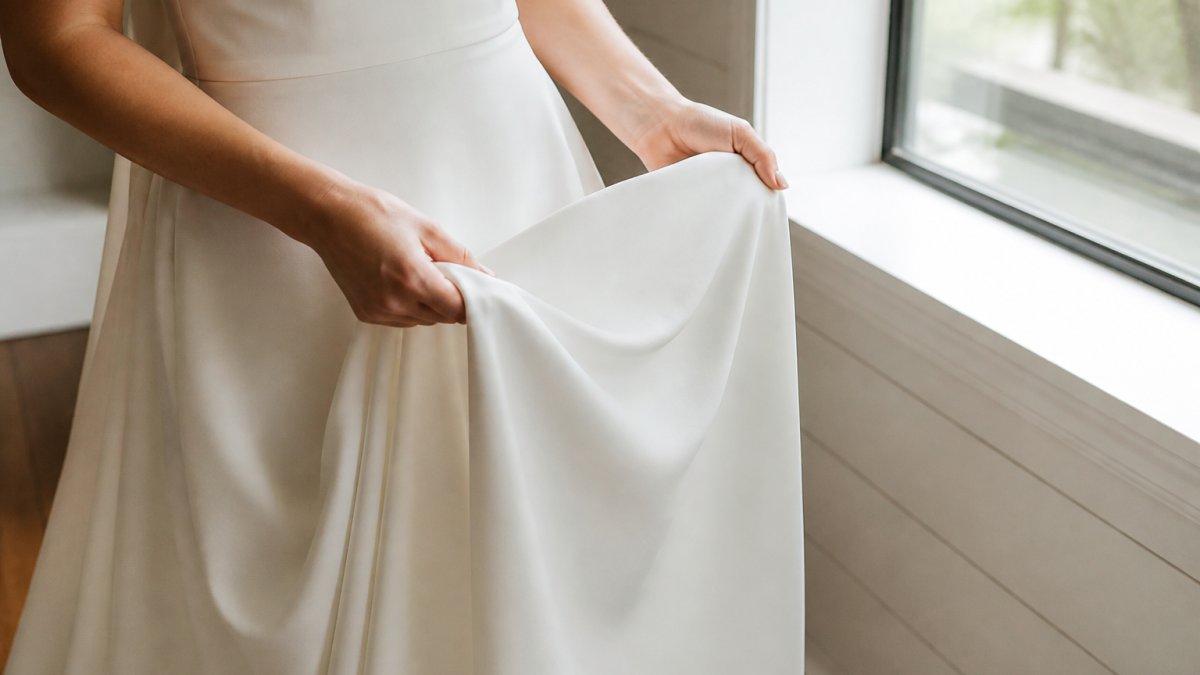
Our long crepe dress with lace sleeves is made from a soft but thick crepe with lace sleeves.
Casual short wedding dress, Engagement party, beach wedding, elopement →

Charmeuse is the glossy one. It feels cool and liquid against the skin and photographs with a sheen, but it shows every crease and can cling in humidity. It suits indoor evening ceremonies more than a beach at noon.
Mikado is the structured option, and it is a fabric choice you can ask about when ordering a cape or bodice.
Our deep V-neck silk top is an off-white pure heavy silk top suited to a small wedding or engagement party.

Choosing a Wedding Dress Fabric for Summer and Warm Climates
Dry heat versus humid heat. In dry heat, airflow matters most: chiffon, organza, tulle, and lightweight crepe let air move and evaporate perspiration.
Indoor air conditioning and temperature swings. Many summer weddings move from an air-conditioned ceremony to an outdoor cocktail hour and back inside for dinner.
Beach and outdoor settings. Wind and sand change the equation. Flowing fabrics like chiffon handle breeze gracefully; stiff fabrics fight it.
What to avoid in heat. Heavy Mikado, taffeta, velvet, and densely beaded or corded lace trap heat and add weight. Coated or non-breathable polyester linings defeat a breathable shell.
Comfort across the full day. Warm-weather comfort is not just about the ceremony. Think about sitting through a meal, walking on grass or sand, dancing, and bathroom breaks in a floor-length gown. A circle skirt in soft crepe gives you room to stride; a fitted mermaid in a low-stretch fabric will fight you every time you sit. If your venue is a minimalist courthouse or garden affair, our guide to a minimalist wedding dress for a courthouse ceremony goes deeper into matching a simple silhouette to the setting.
For a warm-weather wedding, shortlist chiffon, organza, tulle, and lightweight crepe, confirm a breathable lining, and test the dress sitting, walking, and standing in warm light before you decide.
Try-On and Alteration Checklist for Comfort
Comfort is decided in the fitting room, not on the hanger. Use this checklist every time you try a dress on, and bring the shoes and undergarments you plan to wear.
- Sit down for two full minutes. Does the bodice dig in or ride up?
- Walk across the room and up a flight of stairs. Can you move without lifting the skirt?
- Raise both arms overhead. Do the sleeves or armhole bind?
- Turn and twist at the waist. Does the fabric pull across the back?
- Check the lining content. Is it breathable and smooth against skin?
- Feel the seams at the bodice and underarms for scratch or bulk.
- Stand under warm light for five minutes. Does the fabric feel clammy?
- Confirm the hem length works with your shoes.
For alterations, prioritize the bodice fit and armhole comfort first. A dress that pinches at the underarm will ruin an otherwise perfect gown, and it is far easier to fix before the final fitting than the week of the wedding.
Book a Made-to-Measure Fitting at TABD BRIDAL
The fastest route to a comfortable wedding dress is a gown cut to your measurements rather than a standard size you then pay to alter. That is what our made-to-measure service is for.
Our made-to-measure dresses ship in two to four weeks. You choose the fabric and silhouette that suit your season and setting. If you have settled on a fabric you love, you can book a made-to-measure dress in that material and skip the alteration cycle entirely.
Comfort on your wedding day is not a luxury. It is a decision you make when you choose the fabric, and it is one we help brides get right every week.
Frequently Asked Questions
Which wedding dress fabrics are most breathable?
Chiffon, crepe, organza and lightweight silk allow the most airflow because they are woven thin and sit loosely against the body. Tulle is airy in the skirt but can feel scratchy at the waist. Structured fabrics like Mikado, duchesse satin and velvet trap heat, so they suit cool-weather ceremonies better. If your venue is warm or you plan to dance for hours, start with chiffon or crepe and add structure only where you need it, such as a fitted bodice.
Is satin comfortable to wear for a wedding?
Satin can be comfortable, but it depends on the weight and the cut. Heavy duchesse satin holds its shape and looks formal, yet it has little stretch and can feel stiff after several hours. Lighter satin linings work well under breathable layers. Look for a dress with a natural-fiber lining, a bodice that does not dig in at the arms, and a skirt wide enough to walk and sit in. Try sitting, climbing stairs and raising your arms before you commit.
What wedding dress fabric is best for a summer ceremony?
For summer, choose lightweight wedding dress materials such as chiffon, crepe, organza or silk faille in a lighter weight. These fabrics let air move and keep the silhouette flowing rather than clinging. Avoid velvet, heavy Mikado and unlined tulle against the skin. A midi or short hemline also helps, and an off-white or ivory tone reflects heat better than a dense dark lining. Pair the dress with minimal underlayers so humidity does not turn the skirt heavy.
How can I tell if a wedding dress fabric will feel comfortable all day?
Test the fabric the way you will wear it. Sit down for five minutes, walk across the room, raise your arms and bend at the waist. Check the seams under the arms and at the waist for rubbing, and feel whether the lining breathes against your skin. Ask what fiber content the fabric has, since blends behave differently from pure silk or polyester. A made-to-measure dress removes most fit-related discomfort, because the bodice follows your body instead of pulling at the shoulders.
Ready to feel good in your gown from the first look to the last dance? Get started with TABD BRIDAL and choose a made-to-measure dress in a fabric that suits your season, your venue, and your body.
